Activism, Struggle & Labour History
16th Biennial Conference of the Australian Society for the Study of Labour History, hosted by the Perth branch of ASSLH and held on 3-5 October 2019
Approximately 90 historians, unionists, activists and supporters gathered recently for the 16th Biennial Conference of the Australian Society for the Study of Labour History, hosted by the Perth branch of ASSLH and held on 3-5 October at Perth Trades Hall building (now CFMEU offices). Led by convener Bobbie Oliver, the conference was a great success and even made a small profit. The CFMEU did us proud, generously providing its premises free of charge. Only one thing was dispiriting — the absence (through recent death) of our long term and respected president Neil Byrne.
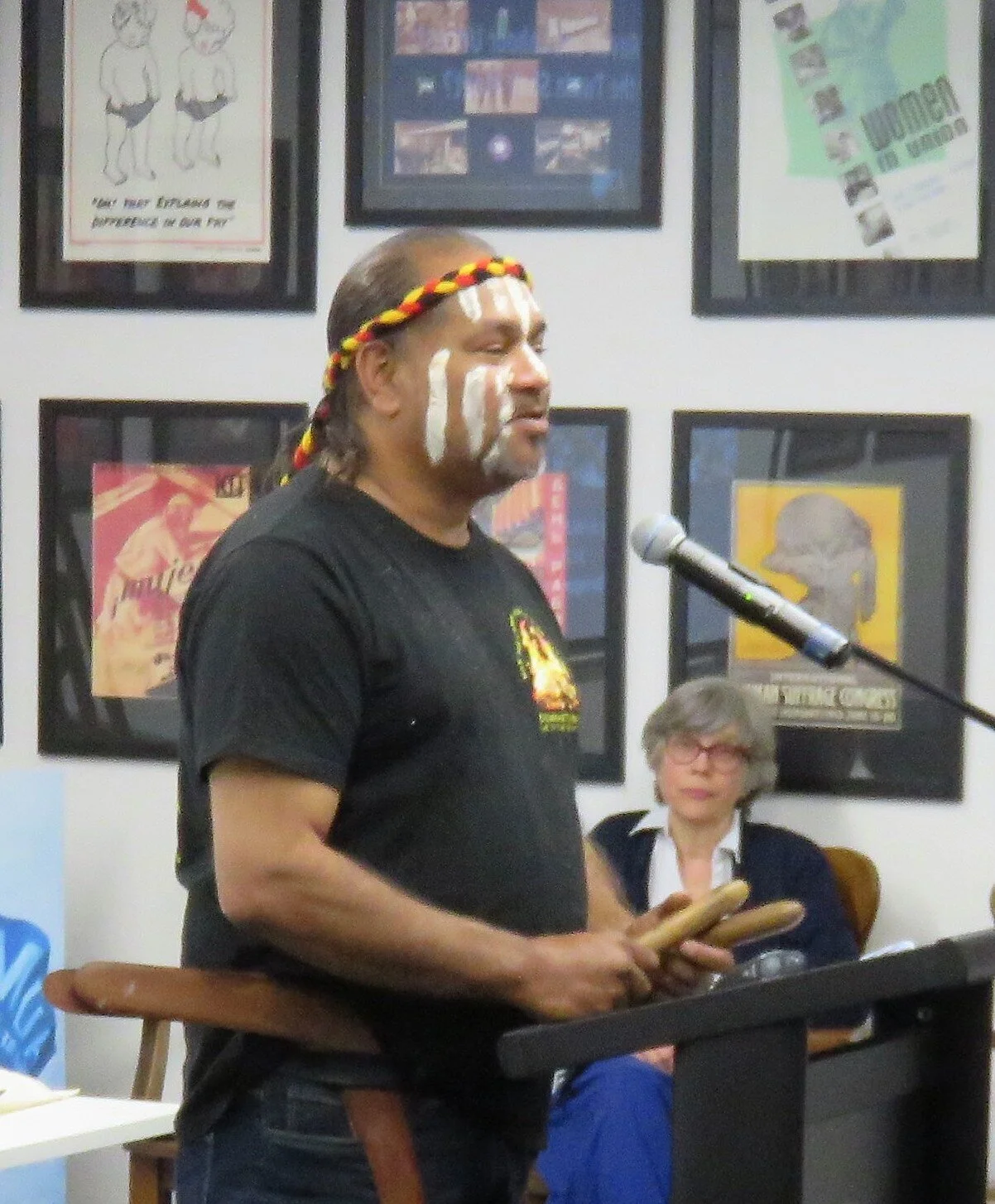
Vaughan McGuire
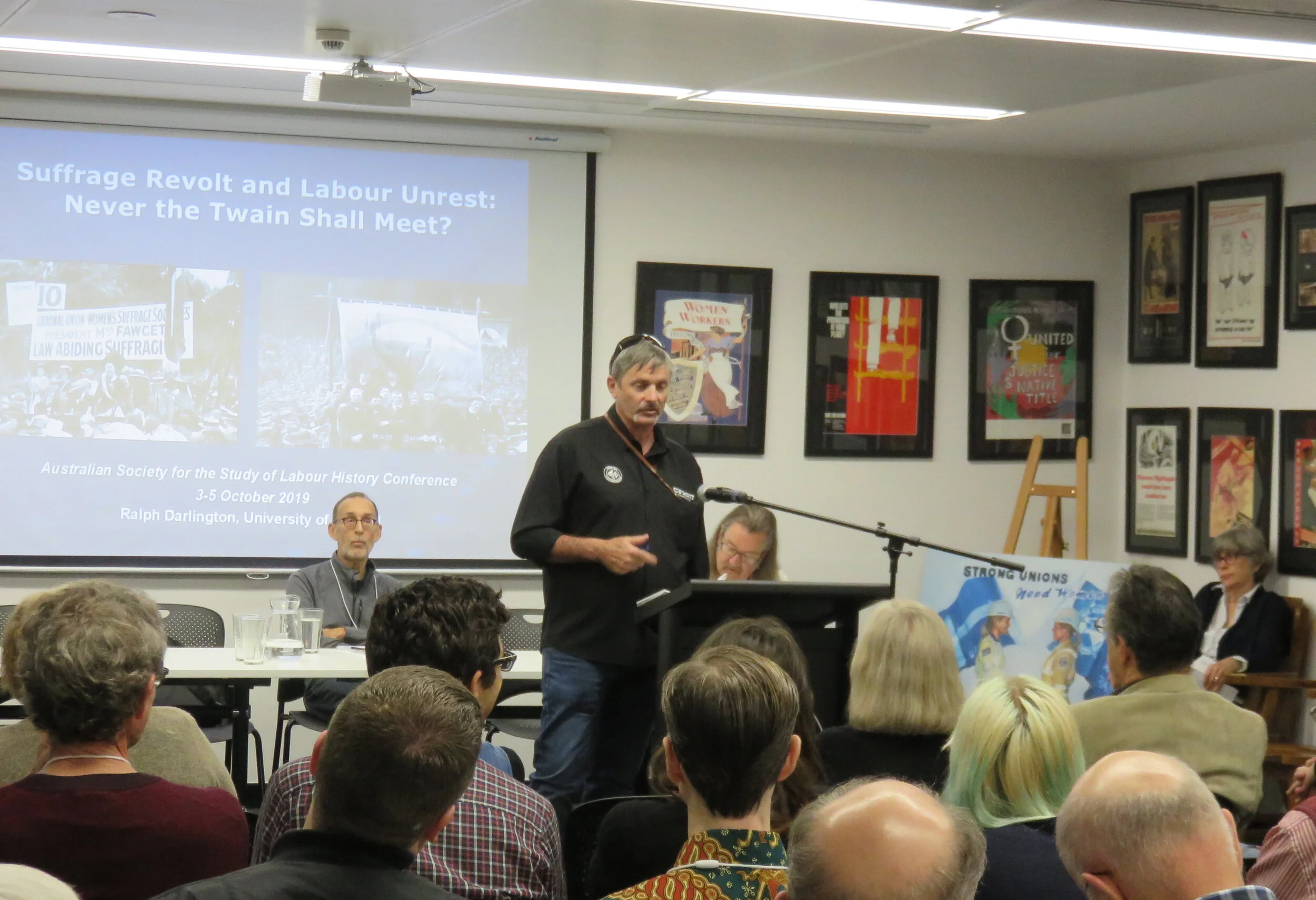
Mick Buchan: Photo Ron Knox
A three-day conference with three parallel sessions, most often with three papers in each session, offers a challenging array of choices. Tiring certainly, but chiefly intellectually invigorating, with ideas, insights and arguments aplenty. Choice was difficult. Three plenaries anchored proceedings. Professor Ralph Darlington (Em. Prof. Employment Relations, Salford University, UK) led off with an address searching for unexplored interconnections between the women’s suffrage movement and the labour movement in pre-1914 Britain. Identifying hitherto unexamined linkages and interconnections also engaged Dianne Kirkby (Prof. Law & Humanities, UTS). Her address on maritime labour in 20th century Australia integrated a history of colonialism and male/female labour with that of labour mobility and unfree labour. Both these plenaries set out to question historical orthodoxies as did many subsequent conference papers, making for stimulating listening. The third plenary, led off by ACTU secretary Sally McManus and chaired by Meredith Hammat, UnionsWA secretary, proved particularly challenging as speakers and questioners grappled with today’s adverse political climate and the need for new strategies to connect with and assist working people alongside a commitment to press on doggedly where the cause is just.
Choosing among the parallel sessions creates different conferences for everyone attending. Particularly telling for me was a session by Jane Lydon, Ann Curthoys and Jeremy Martens which analysed the links between the end of British slavery, convict transportation and Aboriginal dispossession. Jane Lydon argued that the system of convict transportation was shaped by slavery as well as being another form of unfree labour. Fortunes won from slavery as well as former slave-owning families themselves spread around the empire seeking new opportunities, the spread now documented in the Legacies of British Slave Ownership website at https://www.ucl.ac.uk/lbs/. Jeremy Martens linked the York Agricultural Society’s push for forced labour with the violent dispossession of Aboriginal communities on the Avon throughout the 1830s. Finally in this interesting session, Ann Curthoys reviewed labour history writings over time within the frame of settler colonialism, arguing that readings of settler colonialism need to evolve to embrace indigenous dispossession and the ongoing role of unfree labour.
A number of conference papers explored labour struggles in their international context— for instance, Heather Goodall spoke on the ILO, Julia Martinez and Claire Lowrie on Chinese indentured labour, and papers discussed labour struggles in New Zealand, Ireland, the USA, Sweden, Malaysia, the Philippines and India. National differences as well as radical commonalities were clear. Reminders of the ongoing importance of indentured and other forms of unfree labour recurred. Women’s history also found a strong place, and of particular interest was the session ‘Women at birth and in battle’ featuring Bri McKenzie and Clare Davison on the changing place of midwives while Sarah Fulford examined Australian nurses at war.
Radical publishing was also a popular topic. Janey Stone provided an historical overview of its Australian history, ending with her contemporary Red Swan series. Two book launches celebrated additions to the field — Stuart McIntyre launched an expanded second edition of Radical Perth Militant Fremantle, edited by Charlie Fox, Alexis Vassiley, Bobbie Oliver & Lenore Layman (Interventions Inc., 2019), while Janet Holmes a Court launched Dylan Hyde’s Art Was Their Weapon. The Perth Workers’ Art Guild (Fremantle Press, 2019). I recommend both to readers.
Charlie Fox and Bobbie Oliver organised two trips off site — Charlie to lead a walk around militant Fremantle sites and Bobbie to the HIVE at Curtin University — while the CFMEU organised a tour of the old Trades Hall building. As well, approximately 60 people had an enjoyable conference dinner at Red Opium Restaurant.
Altogether it was a packed and interesting three days. An encouraging array of postgraduate students giving papers offers hopes for the future of the intellectual area, and the diversity of presenters’ topics suggests that the large umbrella of labour history is accommodating a rich variety of voices.
Lenore Layman
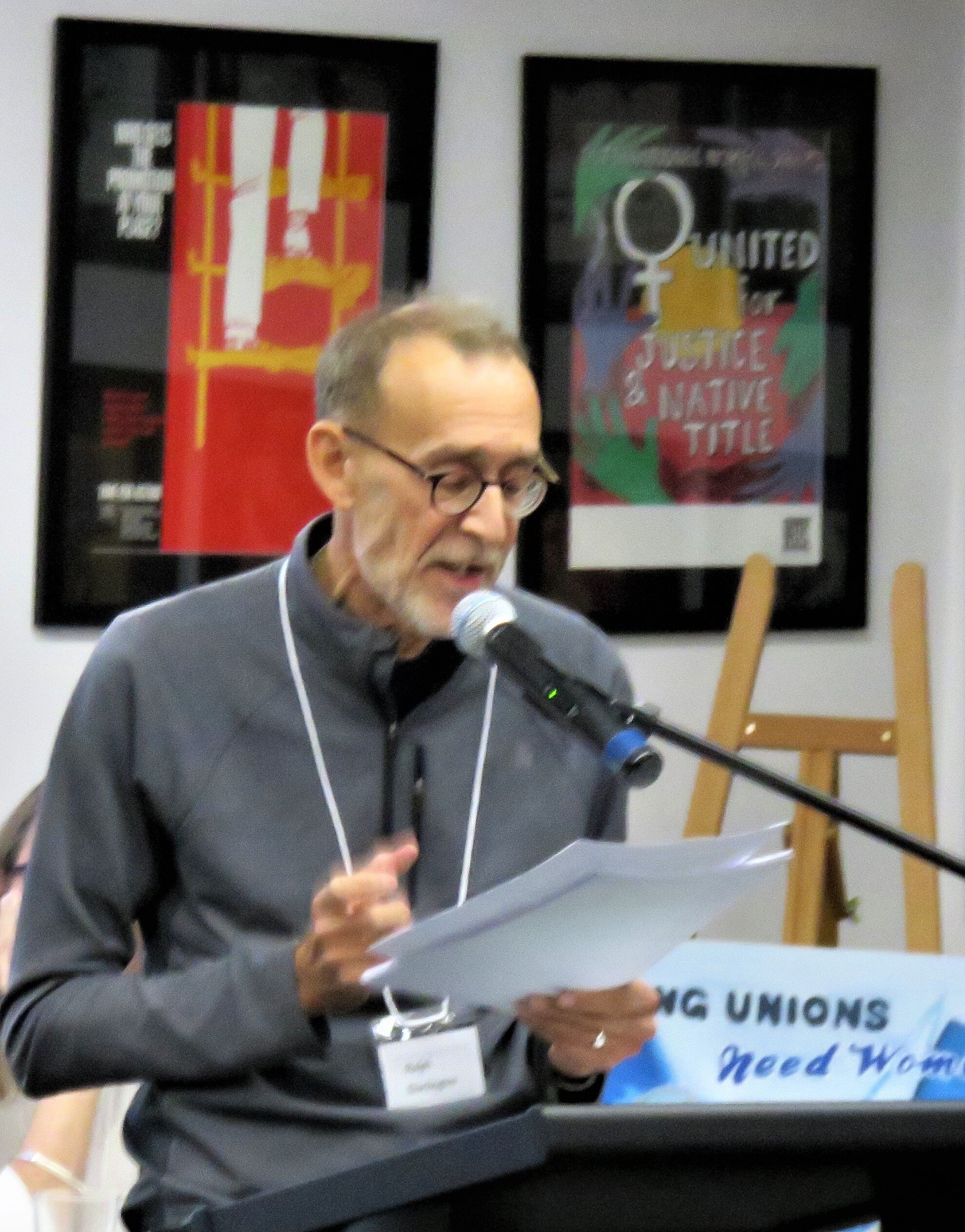
Ralph Darlington
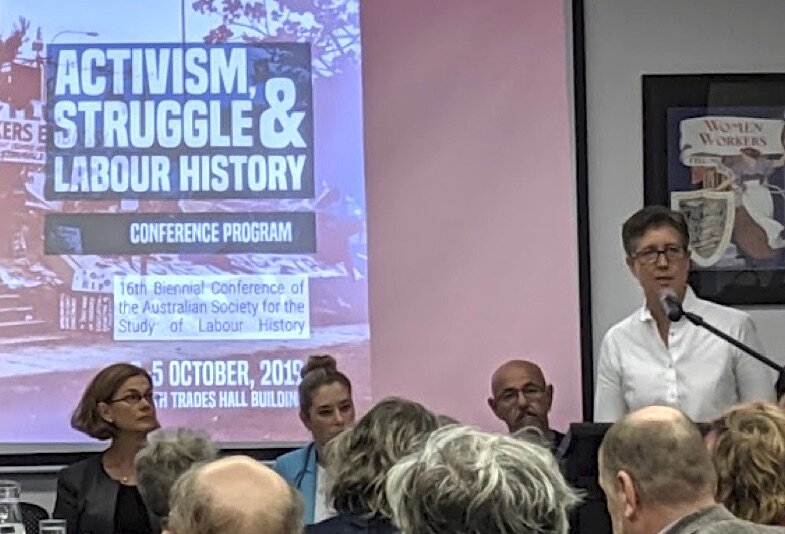
Union panel at conference: Photo Ron Knox